Explore / Strategy and chance
The Monty Hall problem. Should you switch doors?
Three doors, one car and two goats. A seemingly obvious answer which has fooled most people, even some of the world's best mathematicians.
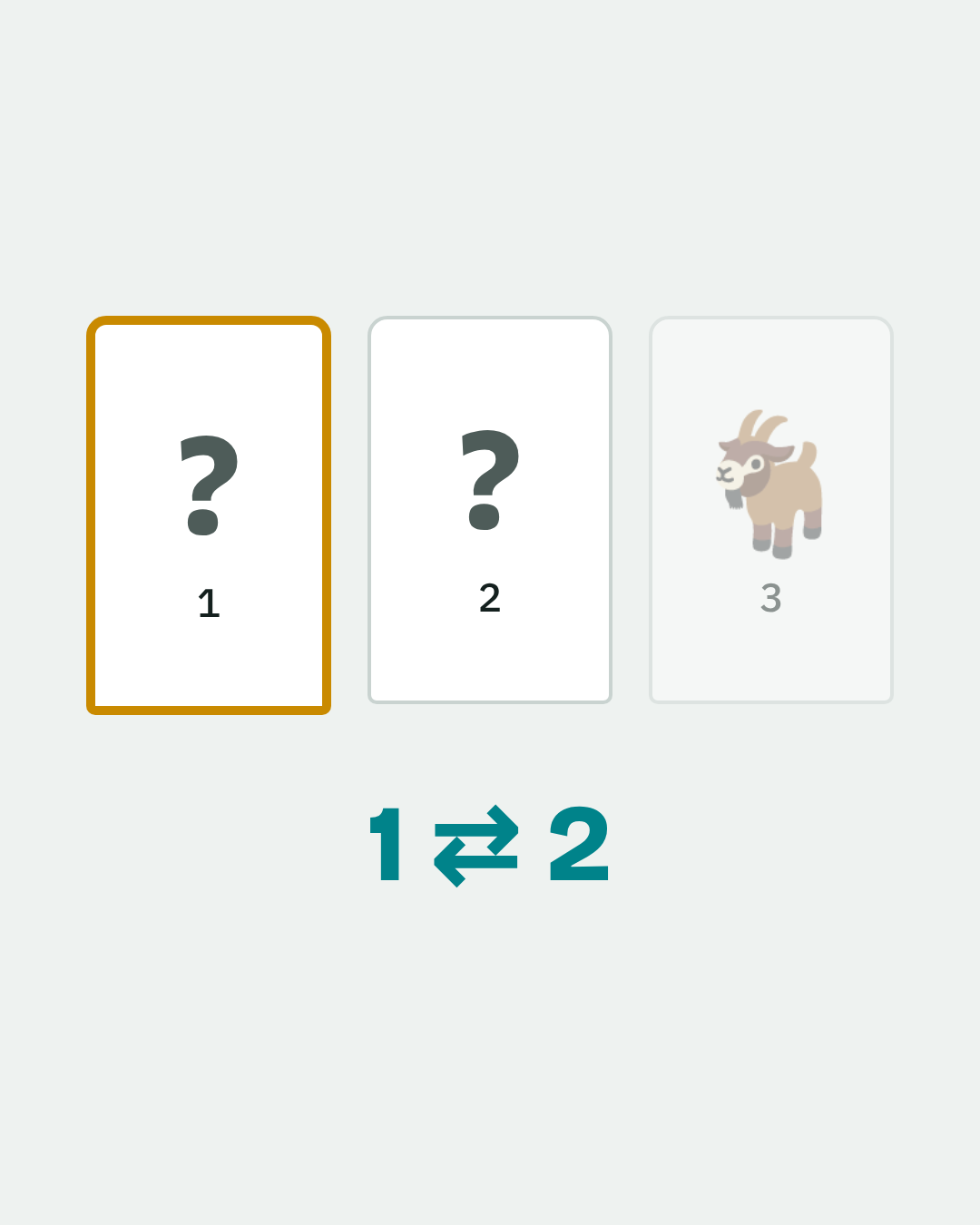
You are on a game show where you can win a car. If you win, you can finally go on that trip you and your loved ones have talked about. The host is a former MI5 agent, but that is entirely irrelevant here, and something only we know.
You see three doors in front of you. Behind two of them is a goat. Behind the last one is a car.
The host asks you to pick a door. You choose one, but do not open it. The host then opens one of the other two doors, revealing a goat. One door down, two to go. Then the host asks: "Would you like to switch to other remaining door, or stick with your initial choice?"
Most people assume it makes no difference: two doors left, so it must be fifty-fifty. That is wrong. If you stay, your chance of winning is 1/3. If you switch, it rises to 2/3!
Try it
Play a few rounds. Try both staying and switching, and see how you get on.
The pattern may not be obvious after a handful of rounds. Randomness is indeed lumpy, but the longer we play, the closer we get to 1/3 and 2/3.
1 000 rounds
Let's have the computer play the game a 1 000 times instead. The simulation always switches, and in each round it also works out what staying would have given. The chart shows the share of rounds in which each strategy (stay and switch) wins the car.
Initially, the win rates fluctuate a lot, but by the law of large numbers they settle nearer and nearer their mathematically true probabilities: 2/3 for switching and 1/3 for staying.
Why switching wins
The probability changes because the host doesn't open a random door. Your door and the car's door are never opened.
Your first pick is one door out of three, so you have a 1/3 chance of winning. That does not change when another door is opened. When the host opens a door, you are in one of these situations:
| First pick | Chance of first pick | Host removes | Winning strategy |
|---|---|---|---|
| Car | 1/3 | Goat 1 or 2 | Stay |
| Goat 1 | 1/3 | Goat 2 | Switch |
| Goat 2 | 1/3 | Goat 1 | Switch |
So switching gives you a 1/3 + 1/3 = 2/3 chance of winning.
Imagine 100 doors. You pick one. The host opens 98 of the others, all with goats. Is the car more likely to be behind the door you picked first, or behind the one other door the host chose to leave shut? This is same game as we have played, just a bit clearer.
It fooled the experts too
In 1975, the statistician Steve Selvin described the problem in a letter to The American Statistician.
In 1990, Marilyn vos Savant answered "switch" in the magazine Parade. She received thousands of letters saying she was wrong, many from people with doctorates.
Paul Erdős, one of the most prolific mathematicians in history, was one of the sceptical ones. According to his biography, he was not convinced until he saw a computer simulation, much like the one above.
But mind the assumptions
The 2/3 answer assumes that the host always opens a goat door and always lets you switch. If you are only offered a switch when you have picked the car, you should stay, because the offer itself tells you that you have already won.
It is called the Monty Hall problem because it is based on the American TV game show Let's Make a Deal, hosted by Monty Hall. In an interview with the New York Times in 1991, he said he decided case by case whether to let contestants switch. So the maths problem did not always match the game on Let's Make a Deal.
Make your own simulation in Excel or the like
- We assume the car is behind Door 1. First row is headers, following are games.
- First column - "First pick" (A1): Set the first cell (A2) under the header as a random number between 1 and 3. For Excel, =RANDBETWEEN(1;3).
- Second column - "Removed door" (B1). Says which door the host removes, based on your choice and where the car is. If you choose Door 2, Door 3 is removed. If you choose Door 3, Door 2 is removed. If you choose Door 1, either Door 2 or Door 3 is removed (doesn't matter). For Excel, B2 is =SWITCH(A2, 1,2, 2,3, 3,2).
- Third column - "Stay" (C1). Says if the Stay strategy gave a win or loss. C2 is =IF(A2=1, "Win", "Loss").
- Fourth column - "Switch" (D1). Says if the Switch strategy gave a win or loss. D2 is =IF(A2=1, "Loss", "Win").
- Mark A2 to D2 (A2:D2), and drag it down to row 1 000 or something.
- Name cells G1 to "Stay", H1 to "Switch", F2 to "Win" and F3 to "Loss"
- Set G2 to =COUNTIF(C:C, "Win"), G3 to =COUNTIF(C:C, "Lose"), H2 to =COUNTIF(D:D, "Win"), and H3 to =COUNTIF(D:D, "Lose"). You now have a summary of wins and losses
- You can convert these to percentages by adding /(COUNTA(C:C)-1) and /(COUNTA(D:D)-1) to all formulas
- Save the file. Press CTRL+S and the random number formulas recalculate. The win percentage for each stragegy will vary, but be close to 1/3 and 2/3
Probability is about what you know. When someone who knows the answer makes a choice, you learn something, even if it does not look that way.