Explore / Strategy and chance
The prisoner's dilemma. Why do two clever prisoners end up with the worst outcome?
For both's sake, they should stay silent. For their own sakes, they don't.

You and a friend have pulled off a robbery! Well, sort of, the police doesn't have enough on you to convict you for the robbery itself, but they do have enough to convict you for a lesser offence (smaller crime). Now you're in separate interogation rooms. The police naturally wants the case solved and tempt you with the following options:
- If both stay silent, you are only charged with the lesser offence and get 1 year.
- If you confess and friendo stays silent, you go free, while your friend (?) gets 10 years.
- If both confess, you both get 6 years.
You cannot talk to each other, and you do not know what the other will choose.
Both of you know that the best outcome for the two of you taken together is to stay silent and get 1 + 1 years in total. Yet that is not always how it turns out.
You might reason as follows:
- If your friend confesses, you get 10 years if you stay silent and 6 years if you confess.
- If your friend stays silent, you get 1 year if you stay silent, but 0 years if you confess.
Either way, you get a shorter sentence by confessing. The same goes for your friend.
Perhaps you are not that cynical and perhaps you stay silent. Are you sure your friend is thinking the same? And even if you are, are you sure your friend does not think you will confess, and therefore confess for that reason?
This means both confess more often than you would like. You could have had 1 + 1 years, but in the hope of getting 0 + 10, you're more likely to end up with 6 + 6 years.
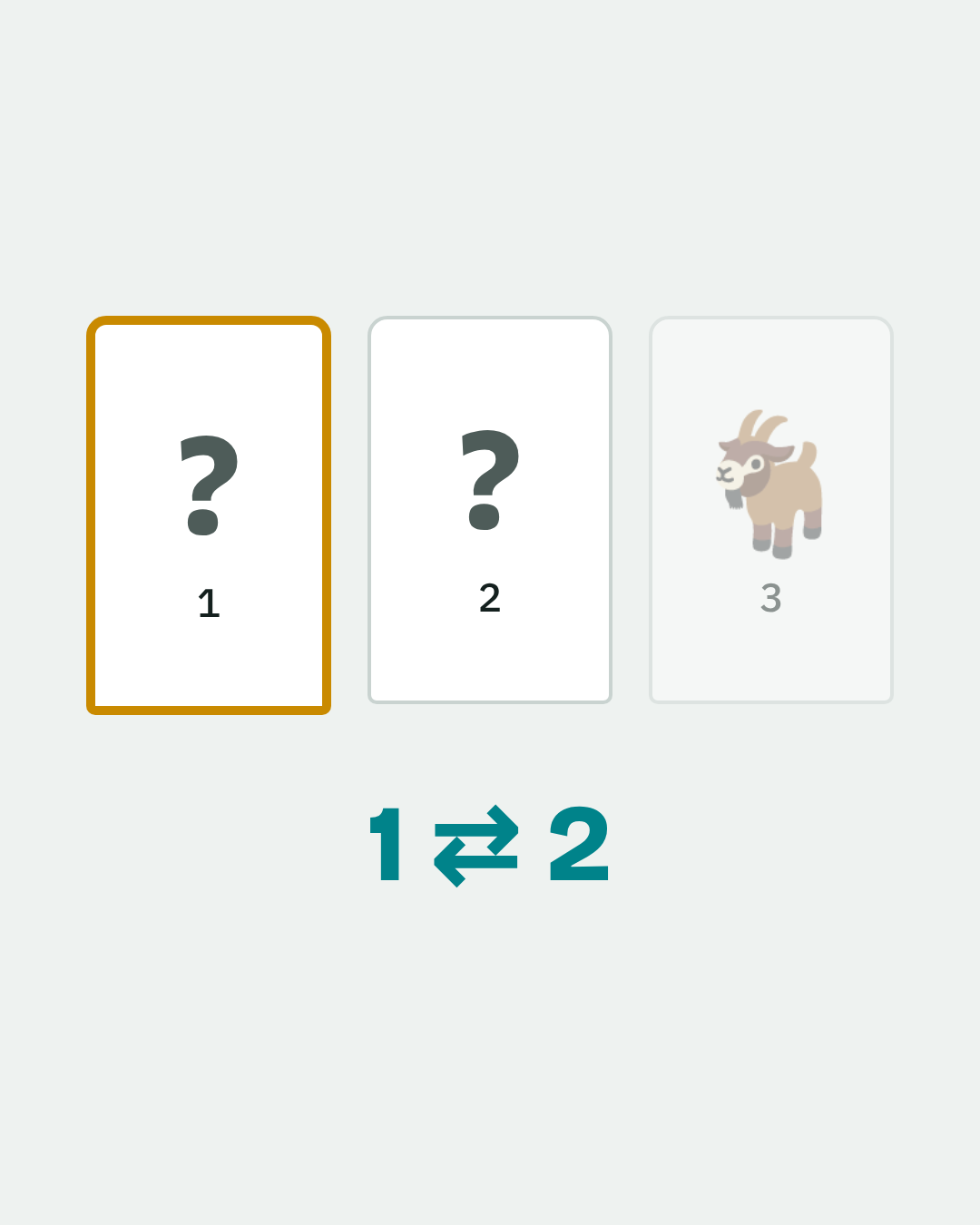
Press the button under the table to see what pays off for each of you. The arrows all point the same way: towards the corner where both confess.
Try it
Nash equilibrium
The corner where both confess is a so-called Nash equilibrium. Don't you just love the word equilibrium? Nash equilibrium is a fancy way of saying that neither player gains by changing their own choice as long as the other sticks with theirs. If you are there and switch to staying silent on your own, you get 10 years instead of 6. The same goes for the other.
In 1950, the mathematician John Nash showed that such equilibria (fancier, because plural!) exist in a great many games. Later, in 1994, he was awarded the Nobel Prize in economics (formally the Sveriges Riksbank Prize in Economic Sciences in Memory of Alfred Nobel).
And "games" does not just mean actual games, but mechanisms in society and the economy where everything pulls in a direction nobody really wants. The pattern turns up whenever each individual gains by defecting, while everyone loses if everyone does:
- The tragedy of the commons: Each farmer gains by putting one more sheep on the shared pasture, but when everyone does, the pasture is ruined. The same applies to overfishing and deforestation.
- Arms races: Both countries would be safer and richer without arming, but neither dares hold back while the other might not.
- Doping: Each athlete gains by doping, but if everyone does, nobody gets an advantage. They just take on the risk.
- Climate: Each country gains by letting others bear the cost of cutting emissions.
- Price wars: Two shops both gain from high prices, but each gains by cutting its price slightly to win the other's customers.
How do you get out?
Whenever people are part of a calculation, the answer is never set in stone. There are, for example, people who buy more when prices increase. But it gives us a sense of which way things are likely to go, and changing the assumptions changes how the game plays out For instance, if you:
- Repeat the game: In the 1980s, the political scientist Robert Axelrod showed that when the same game is played many times, it often pays to cooperate, and to defect only once the other has defected first. Then you have something to lose by defecting.
- Make agreements and rules: Contracts, laws, doping tests and fishing quotas make defecting more costly.
- Build communities: The economist Elinor Ostrom won the Nobel Prize in economics in 2009 for showing that many local communities manage shared resources themselves, without the tragedy of the commons playing out.
The prisoner's dilemma shows that it is not enough for everyone to be logical and sensible. Sometimes the rules of the game have to change.